
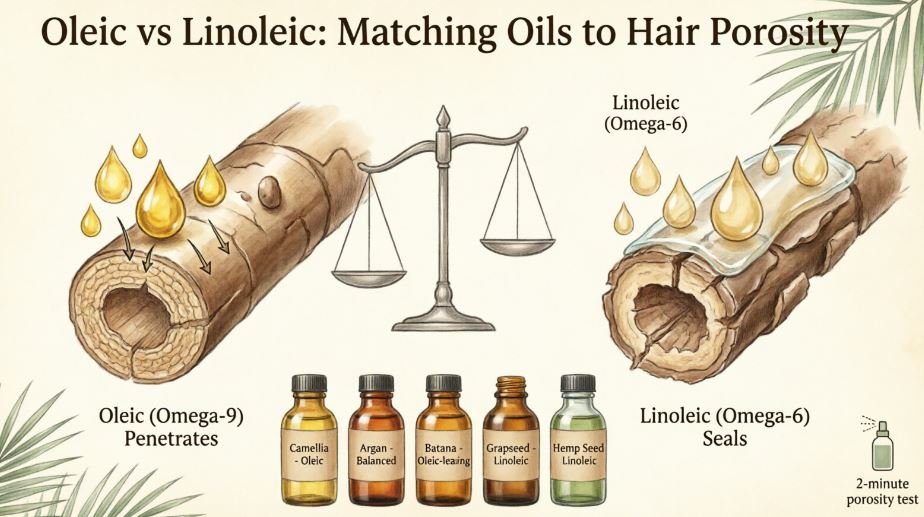
The best oleic acid and linoleic acid balance for hair porosity is not a magic ratio printed on a bottle. It is a matching game: penetrating fats for hair that resists moisture, sealing fats for hair that loses it too fast. Here is the honest takeaway up front: low porosity strands usually feel better with oleic-leaning oils in small warmed doses, high porosity strands prefer a penetrate-then-seal pair, and medium porosity gets along with balanced oils. This guide explains why, in plain science and without hype.
Oleic acid (omega-9) tends to absorb into the hair shaft and carry moisture inside. Linoleic acid (omega-6) tends to stay on the surface, sealing moisture in and supporting the scalp barrier. The “best balance” depends on your porosity, not on a trend.
You bought a viral oil, and it just sits on your hair like a plastic film. Or it vanishes within an hour and your ends feel straw-like by evening. Neither means the oil is bad — it usually means its fatty acid profile does not match your cuticles.
Key Takeaways
- Oleic penetrates, linoleic seals; porosity decides which job your hair needs most.
- Low porosity: warmed oleic-leaning doses, minimal daily sealing.
- High porosity: penetrate pre-wash, then seal over water-based moisture.
- Medium porosity: balanced oils like argan, baobab, or batana cover both roles.
- Flaky scalps should keep heavy oleic oils off the scalp, and scarring conditions belong with a dermatologist.
Oleic vs Linoleic: The Two Fatty Acid Families Your Hair Feels
Every plant oil is a mixture, but one family usually leads. That leading profile decides whether an oil sinks in, sits on top, or talks to your scalp.
Oleic acid (omega-9): the penetrator
Oleic acid for hair behaves like a moisture courier. It is a monounsaturated fat, slightly heavier in feel, and known for absorbing into the shaft rather than merely coating it. Olive, avocado, sweet almond, camellia, marula, and batana oils all lean oleic.
Because it moves inward, oleic-rich oil softens from the inside and adds flexibility to stiff strands. That is why coarse, dry, or tightly closed hair often loves it, while fine hair can feel weighed down by too much.
Linoleic acid (omega-6): the sealer and scalp partner
Linoleic acid for hair is polyunsaturated, lighter, and more surface-oriented. Comparative hair research has long observed that linoleic-rich oils such as sunflower tend to coat the shaft instead of penetrating deeply.
That coating is not a flaw. It slows moisture escape, adds slip for detangling, and on the scalp, linoleic acid feeds the ceramide layer that keeps the barrier calm and flake-resistant. Think of it as the guard at the door rather than the guest inside.
Stability matters: why linoleic oils age faster
Polyunsaturated fats oxidize quicker than monounsaturated ones. A grapeseed or hemp seed bottle kept near a sunny window can turn rancid in months, smelling paint-like or metallic. Oleic-rich oils tolerate storage better, which is one practical reason traditions favored them for long-term use.
Why the ratio shows up on your strands
Your cuticle is a door. Oleic knocks and walks in; linoleic stands guard outside. When the door style (porosity) and the oil job (penetrate vs seal) mismatch, you get buildup or straw — the two complaints behind almost every “this oil failed me” review.
Hair Porosity in Plain Words
Porosity describes how easily water and oils move through your cuticle layer. Genetics set the baseline, while heat, color, sun, and friction reshape it over time.
Low porosity: the tightly closed door
Cuticles lie flat and overlap tightly. Moisture struggles to enter, and products stack on top as buildup. This hair shines for days after washing, then feels coated and dull if over-oiled.
High porosity: the leaky roof
Cuticles are raised or chipped from damage. Water rushes in and rushes out, bringing frizz, tangles, and quick dryness. This hair drinks product but never seems satisfied.
What changes porosity over time
Repeated bleaching, hot tools, and UV exposure lift cuticles, moving hair toward the high end. That is why the oil that worked at twenty can feel useless at thirty, and why porosity deserves a re-check every year or two.
The 2-minute home test
A simple hair porosity test: spray clean, product-free hair with water. Beading that sits for minutes hints low porosity; instant soaking hints high. The old float test is less reliable because residue changes buoyancy, so treat either result as a clue, not a lab verdict.
The Best Oleic and Linoleic Balance for Each Porosity
There is no universal ratio, and any chart claiming one is overselling. The honest answer is porosity-specific, because each cuticle style needs a different division of labor between inside and outside work.
Low porosity: lean oleic, go light and warm
Oils for low porosity hair should prioritize penetration with minimal surface stacking. Use oleic-leaning, light-to-medium oils such as camellia or argan in 2–3 drop doses, warmed between palms, ideally before washing with gentle heat from a shower cap.
The warmth opens the tight door just enough for the penetrator to enter. Daily heavy sealing is where this hair type suffers; save butters for occasional deep treatments only.
High porosity: pair penetration with linoleic sealing
Oils for high porosity hair work best as a two-step pair. Start with a penetrating pre-wash (coconut or babassu) to reduce wash-day protein loss and hygral fatigue. After washing, apply water-based moisture first, then seal with a high linoleic oil like grapeseed or hemp seed, or a richer butter for very coarse textures.
The linoleic layer slows the leaky-roof escape, and its scalp-barrier support helps the flaking that often follows chemical damage.
Medium porosity: balanced oils do it all
If your hair takes moisture and holds it reasonably, balanced fatty acid oils like argan, baobab, sesame, or batana cover both jobs in one bottle. You can alternate penetrate days and seal days without overthinking ratios, and most argan oil fatty acid ratio profiles sit comfortably in this middle zone.
| Oil | Dominant fat | Feel | Porosity fit |
|---|---|---|---|
| Camellia | Oleic | Light, glossy | Low to medium |
| Argan | Balanced | Light-medium | All types |
| Batana | Oleic-leaning, meaningful linoleic | Rich, raw | Medium to high |
| Avocado | Oleic | Medium-heavy | Dry, coarse, high |
| Grapeseed | Linoleic | Very light seal | High, fine |
| Hemp seed | Linoleic | Light, dry-touch | High, scalp-focused |
| Sunflower (high-linoleic) | Linoleic | Light coat | High, budget seal |
| Baobab | Balanced | Medium | Medium to high |
How to Spot an Oil’s Dominant Fat Without a Lab
You rarely see percentages on a bottle, but clues exist. Words like “high-oleic” on sunflower or safflower versions signal a bred-for-penetration profile, while standard versions stay linoleic-rich. Ingredient order in blends hints dominance, since lists run by weight.
Refining also shifts feel: unrefined oils keep more antioxidants and feel richer, while refined versions spread thinner and smell neutral. For porosity matching oils, texture on your skin test matters as much as any label claim — rub one drop on your knuckle and watch whether it sinks or shines.
Quick reference: High oleic oils include olive, avocado, almond, camellia, marula, moringa, and batana. High linoleic oils include grapeseed, hemp seed, evening primrose, rosehip, safflower (standard), and sunflower (standard). Balanced seats go to argan, baobab, sesame, and pumpkin seed.
Where Batana Oil Fits in This Picture
Batana oil fatty acids tell an interesting story: the oil is oleic-dominant but carries a meaningful linoleic fraction, plus natural tocotrienols and carotenoids from its raw processing. That mix explains its traditional reputation — enough penetration to soften coarse strands, enough surface support to calm a dry scalp.
Readers comparing bottled raw versions can see our checkpoint test in the UFNA Batana Hair Oil review. The cultural backstory of the Miskito press method lives in our guide to secret indigenous oils for extreme hair length.
When Oleic Might Not Be Your Friend
Oleic acid has a complicated relationship with flaking. In dandruff-prone scalps, oleic acid is one of the fatty acids implicated in triggering flake responses, which is why heavy olive-oil scalp masks sometimes make shedding flakes worse instead of better.
If your scalp flakes easily, keep oleic-rich oils on lengths rather than the scalp, shorten contact time, or lean on linoleic-light options that support ceramides scalp linoleic acid pathways. For scarring or medical scalp conditions, skip home experiments and see a dermatologist; our upcoming guide on the best natural oils for cicatricial alopecia scalp will cover comfort-only options alongside medical care.
Climate and Season: The Hidden Third Variable
Porosity is not the only dial. Humid climates push hair to absorb atmospheric moisture, so a light linoleic seal after styling tames frizz without weight. Dry winter air pulls moisture out, so a warmer oleic pre-wash becomes more valuable.
Travel between climates often explains sudden “my routine stopped working” moments. Adjust the penetrate-to-seal ratio seasonally before blaming the oil itself.
Fine, Coarse, Curly: Texture Tweaks on Top of Porosity
Fine strands need dose control more than ratio perfection: two drops of a light linoleic oil on ends rarely greases fine hair, while a palmful of anything will. Coarse strands tolerate layering, so a penetrate-seal stack reads as nourishment rather than grease.
Curly and coily textures often show porosity variation zone by zone — roots tighter, ends more open. Treating ends with the high porosity pair and roots with low porosity doses is a legitimate split routine, not overthinking.
Building a Simple Two-Oil Routine
You do not need ten bottles. You need one penetrator and one sealer, used in the right order, observed over weeks.
Step 1: Pre-wash penetrate
Once weekly, apply your oleic-leaning or lauric oil (coconut, babassu, camellia) from roots to ends 30 minutes before shampoo. This cuts swelling and protein loss during washing.
Step 2: Water-based moisture first
After washing, apply leave-in or a plain water mist to damp hair. Oils seal moisture in; they cannot create it, so never seal a dry strand and wonder why nothing changed.
Step 3: Linoleic-light seal
Smooth 3–5 drops of grapeseed, hemp seed, or your balanced oil over the damp hair, focusing on ends. This locks step two in place and adds slip for gentle detangling.
Step 4: Weekly reset and observe
Clarify once a month if shine turns dull, and photograph your hair every four weeks. Two observation cycles teach you more about your personal ratio than any chart. Pair this routine with our to Manage Hair Breakage Naturally checklist for compounding gains.
Common Mistakes With Fatty Acid Oils
Mistake 1: Daily heavy oleic on low porosity. Buildup mimics dryness, so people add more oil and make the coating worse.
Mistake 2: Sealing dry hair. Without water underneath, the seal locks in nothing but friction.
Mistake 3: Fearing all oil on fine hair. Dose, not the oil, is usually the culprit; ends-only application solves most grease complaints.
Mistake 4: Expecting ratios to repair damage. Fatty acids manage moisture and friction; split ends and broken bonds need trims and protein care.
Mistake 5: Ignoring rancidity. A paint-like smell means a linoleic oil has oxidized and should be retired, not rescued.
Three Ratio Claims That Do Not Hold Up
Myth 1: One golden ratio fits every head. Porosity, texture, and climate shift the ideal mix, so personal testing beats copied percentages.
Myth 2: Linoleic oils cannot enter the hair at all. They penetrate minimally; their strength is surface work, not total exclusion.
Myth 3: More oleic means faster growth. Growth lives in follicles and genetics; fatty acids influence retention and feel, not the growth rate dial.
FAQs About Oleic and Linoleic Acids for Hair
Q1: Which is better for low porosity hair, oleic or linoleic acid?
Ans: Oleic-leaning oils usually suit low porosity better because they absorb into tightly closed cuticles instead of stacking on top. Use small warmed doses before washing. Linoleic-light oils can still finish ends, but heavy daily sealing causes buildup on this hair type.
Q2: Is batana oil high in oleic or linoleic acid?
Ans: Batana is oleic-dominant with a meaningful linoleic fraction, plus natural vitamin E and carotenoids. That balance lets it penetrate coarse strands while still supporting the scalp surface, which is why medium to high porosity hair tends to tolerate it well.
Q3: Can high linoleic oils seal high porosity hair?
Ans: Yes, as a light seal. Grapeseed, hemp seed, and high-linoleic sunflower coat the raised cuticle and slow moisture escape without heaviness. Very coarse or extremely porous hair may need a richer butter layered on top for a stronger lock.
Q4: Does oleic acid cause scalp flaking?
Ans: It can contribute in dandruff-prone scalps, where oleic acid is implicated in flake responses. If you flake easily, keep oleic-rich oils on lengths, shorten scalp contact time, and patch test. Persistent flaking deserves a dermatologist’s view, not more oil.
Q5: How often should I use penetrating oils?
Ans: Once a week before washing suits most hair. High porosity or heavily damaged hair may benefit from twice weekly at first, then taper. Low porosity hair often needs less; watch for buildup and clarify monthly if shine turns dull.
Q6: Can I mix oleic and linoleic oils together?
Ans: Yes, blending is a practical way to build your own balance. A simple start is two parts oleic-leaning oil to one part linoleic-light oil for medium porosity, shifted toward more linoleic for high porosity. Mix small batches and store them away from light and heat.