
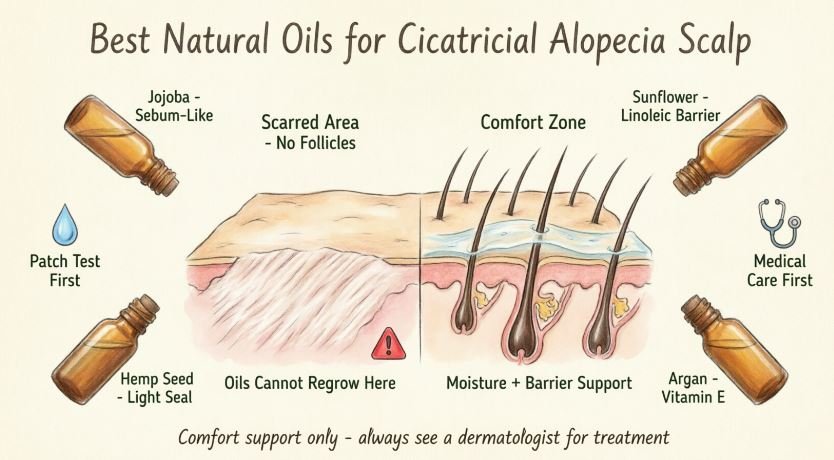
Cicatricial alopecia is a group of scarring conditions in which inflammation destroys hair follicles and replaces them with fibrous tissue. So here is the honest line first: the best natural oils for cicatricial alopecia scalp care are comfort tools, not regrowth tools. No oil can wake a follicle that no longer exists. What the right oils may support is scalp moisturization, softer flaking, and protection of the hair you still have — alongside, never instead of, dermatologist-led treatment.
Quick answer (voice search): No natural oil regrows hair on scarred scalp because the follicles are gone. Gentle oils like jojoba, high-linoleic sunflower, or hemp seed may support dryness, tightness, and flaking comfort. Active burning, itching, or spreading patches belong with a dermatologist, not a bottle.
A scarring alopecia diagnosis arrives with fear: fear of the mirror, fear of the next flare, and fear of wasting money on false promises. Social media keeps selling “regrowth oils” for scars that cannot regrow. This article separates comfort science from fantasy, so your scalp and your wallet both stay protected.
Key Takeaways
- Scarred follicles cannot regrow; oils are comfort and protection tools, never cures.
- Jojoba, high-linoleic sunflower, hemp seed, argan, and baobab are the gentlest comfort starts.
- Keep coconut and oleic-heavy oils on lengths; keep essential oils and fragrance away from flares.
- Patch test 48 hours, apply minimally, and let a dermatologist lead all treatment decisions.
- Daily mechanics — gentle washing, loose styles, sun protection — protect the hair you still have.
What Cicatricial Alopecia Actually Is (and Why Regrowth Claims Fail)
Cicatricial alopecia, also called scarring alopecia, describes conditions in which chronic inflammation attacks the follicle itself. Once the follicle is destroyed, the skin heals with scar tissue and the hair loss becomes permanent in that spot.
Common types include lichen planopilaris, frontal fibrosing alopecia, central centrifugal cicatricial alopecia (CCCA), discoid lupus erythematosus, and folliculitis decalvans. Each behaves differently, but all share the same endpoint: follicle loss with scarring.
| Type | Typical pattern | Notes |
|---|---|---|
| Lichen planopilaris | Patchy loss with redness and scaling around follicles | Inflammatory flare phases |
| Frontal fibrosing alopecia | Receding hairline and brow thinning | Often appears post-menopause |
| CCCA | Crown-centered thinning spreading outward | Linked to traction and heat history |
| Discoid lupus | Disc-shaped patches with scaling | Autoimmune association |
| Folliculitis decalvans | Pustules and crusting with tufted hairs | Needs prompt medical care |
Signs that need a dermatologist soon
Burning, stinging, or pain on the scalp; itching that persists; redness or scaling around patches; smooth, shiny patches where follicle openings have vanished. Early medical treatment aims to halt progression, and the timing window matters far more than any cream or oil.
What medical treatment usually targets
Dermatologists typically focus on calming inflammation with prescription therapies matched to the specific type. The realistic goal is preserving the follicles you still have, not resurrecting scarred ones. That goal is exactly why comfort care and medical care run on parallel tracks.
Where Natural Oils Fit: Barrier, Comfort, and Remaining Hair
Oils for scarring alopecia comfort earn their place in three honest jobs, and only three.
Job 1: Scalp barrier moisturization
Scarred and inflamed scalps often feel tight, dry, and flaky. Light oils rich in linoleic acid support the skin barrier’s ceramide chemistry and slow water loss, which may ease tightness and visible flaking between washes.
Job 2: Gentle surface protection
A thin oil film reduces friction from pillows, hats, and brushes. Less friction means less irritation on sensitive skin and less mechanical stress along the margins of affected patches.
Job 3: Caring for the hair you still have
Remaining strands deserve length-retention care: pre-wash penetration, sealed cuticles, and gentle detangling. Oils are excellent at this job, and it is where traditional oils genuinely shine.
The boundary never moves: scalp barrier support oils comfort and protect. They do not treat inflammation, stop progression, or regrow scarred follicles.
The Gentlest Natural Oils for Cicatricial Alopecia Scalp Comfort
Each option below is chosen for low irritation potential and barrier-friendly chemistry, not for regrowth myths. The 48-hour patch test rule applies to every single one.
Jojoba oil: the sebum look-alike
Jojoba oil for sensitive scalp use is the classic gentle start, because jojoba is technically a liquid wax ester whose structure closely mirrors human sebum. That similarity is why reactive skin usually tolerates it well. It moisturizes without heavy occlusion, making it a sensible first choice for tight, dry scalp areas.
Sunflower seed oil (high-linoleic): the barrier partner
Sunflower oil scalp barrier support comes from its linoleic acid, which feeds the ceramide layer that keeps skin calm and hydrated. High-linoleic sunflower oil is light, inexpensive, and widely used in barrier-care skin research, which is why it translates neatly to flaky, uncomfortable scalps.
Hemp seed oil: the light, dry-touch seal
Hemp seed oil scalp support suits scalps that dislike grease. Its strong linoleic profile absorbs quickly and leaves a dry-touch finish, helpful in humid climates. Store it cool and dark, because polyunsaturated fats oxidize faster than stable oils.
Argan oil: balanced fats plus vitamin E
Argan oil scalp comfort comes from its mix of oleic and linoleic acids with natural vitamin E. It offers middle-weight moisture for both scalp margins and lengths, absorbs cleanly, and rarely leaves a sticky film — which matters when skin feels tender.
Baobab oil: the middle-weight soother
Baobab oil for dry scalp use balances both fatty acid families and includes natural antioxidants. Traditionally applied to dry skin, it may support scalps that find jojoba too light and butters too heavy, filling a useful middle slot.
Coconut oil: lengths only, with a flaking caveat
Coconut oil for hair breakage remains the best-studied pre-wash option for limiting protein loss in strands, so keep it on hair rather than an inflamed scalp. On flaking or dandruff-prone scalps, its fatty acids can feed yeast linked to worse flakes, so scalp use deserves a doctor’s nod first.
Batana oil: tradition-backed comfort for non-scarred areas
Batana oil scalp comfort reflects its oleic penetration, linoleic fraction, and natural tocotrienols. For cicatricial scalps, treat it as comfort care on unaffected zones and lengths, never as scar treatment. Our UFNA Batana Hair Oil review examines one bottled raw version against quality checkpoints.
Oils and Additives to Approach Cautiously on Inflamed Scalps
High-oleic oils and flaking
The oleic acid flaking caution is real: oleic acid is implicated in dandruff-type flaking for susceptible scalps. Heavy olive-oil masks can leave an inflamed scalp itchier, so keep oleic-rich oils on lengths or use small, short-contact doses only.
Essential oils are not gentle defaults
The essential oil irritation risk matters most on compromised skin. Rosemary, peppermint, and tea tree oils carry genuine contact-dermatitis potential, and no evidence supports them for scarring alopecia. Undiluted application can trigger a flare, so dermatologist approval, heavy dilution, and patch testing are non-negotiable.
Fragranced blends and mystery bottles
Perfume ranks among the most common cosmetic allergens. On a scarring alopecia scalp, choose single-ingredient, fragrance-free scalp oils over marketed blends with undisclosed additives and dyes.
Aggressive massage during active flares
The scalp massage caution inflammation rule is simple: massage adds friction and heat. During burning or redness phases, apply with light fingertip pressure only, or pause scalp application until your dermatologist confirms the inflammation is quiet.
How to Patch Test and Apply Oils Safely
Step 1: Patch test for 48 hours
Dab a small amount behind the ear or on the inner arm. Wait 48 hours and watch for redness, itching, or swelling. A scalp with active disease reacts faster than healthy skin, so never skip this step.
Step 2: Start on lengths, not lesions
Apply the oil to mid-lengths and ends first for several washes. Only extend toward unaffected scalp margins if no reaction appears, and keep active patches off-limits unless your doctor agrees.
Step 3: Use minimal doses and gentle touch
Two to three drops warmed between fingertips is enough for margin areas. Press rather than rub, and stop immediately if stinging or heat increases.
Step 4: Rinse on schedule and keep a photo log
Wash out with a gentle, sulfate-free cleanse within a few hours at first. Weekly photos in the same lighting help you and your dermatologist see whether comfort is improving or irritation is building.
A Simple Weekly Comfort Routine
Day 1: Lengths mask
Apply your penetrating oil (coconut or babassu) to strands for 30 minutes before washing. This protects the hair you still have from wash-day protein loss.
Day 3: Margin comfort dose
Press two to three drops of jojoba or high-linoleic sunflower oil onto unaffected scalp margins only. Skip entirely during active flares.
Wash day: Gentle cleanse plus photo
Use lukewarm water and a mild, sulfate-free cleanse, then pat dry with a microfiber towel. Take your weekly photo in consistent light for the log.
Weekly: Review and prepare questions
Compare photos, note any stinging or new patches, and write questions for your next dermatology visit. Comfort care works best when it feeds medical care with clear observations.
Everyday Habits That Protect Remaining Hair
Comfort oil is one piece; daily mechanics decide how much hair you keep. Wash with lukewarm water washing habits and a mild cleanse, because hot water strips barrier lipids. Dry by patting, never scrubbing.
Avoid traction styles, tight edges, and heat tools along affected margins — traction style avoidance is core CCCA hair care advice. Sleep on a satin pillowcase to cut satin pillowcase friction and keep styles loose at night; the same principles appear in our to Manage Hair Breakage Naturally guide.
Protect scarred skin from sun: hats or scalp SPF prevent burning on tissue that no longer has follicle shade — scalp sun protection scar tissue is an overlooked habit. And remember that cosmetic confidence tools, from fibers to toppers to wigs, are valid, respectable options while treatment runs its course.
Batana, Porosity, and Traditions: Where They Fit Here
Readers arriving from our cluster often ask how fatty-acid science applies to a scarring scalp. The short version: porosity matching still governs the hair you have — see Best oleic acid and linoleic acid balance for hair porosity — while cultural oil traditions explain why comfort rituals endure — see secret indigenous oils for extreme hair length. Neither changes the medical reality of scarred follicles, and both enrich the care of everything else.
FAQs About Natural Oils and Cicatricial Alopecia
Q1: Can any natural oil regrow hair on cicatricial alopecia scars?
Ans: No. Scarring alopecia destroys follicles permanently, and no oil, serum, or massage can rebuild them. Medical treatment aims to stop further loss while follicles remain. Oils belong in the comfort and hair-protection lane only. Anyone promising scar regrowth is selling fantasy, so keep your dermatologist as the treatment lead.
Q2: Which oil is gentlest for a scarring alopecia scalp?
Ans: Jojoba and high-linoleic sunflower or hemp seed oils are the usual gentle starts, because they mimic sebum or support the skin barrier without heaviness. Patch test for 48 hours first, apply tiny doses to unaffected margins, and stop at any stinging. Your dermatologist’s approval always comes before any bottle.
Q3: Is coconut oil safe for cicatricial alopecia?
Ans: On hair lengths, yes — it remains the best-studied pre-wash oil for limiting protein loss. On the scalp itself, caution applies: its fatty acids can feed yeast linked to flaking, and inflamed skin may react. Keep coconut on strands unless your dermatologist explicitly okayes scalp use.
Q4: Should I massage oil into an inflamed scalp?
Ans: Not during active burning, redness, or pain. Massage adds friction and heat that can aggravate inflammation. Use light fingertip pressing instead, or pause scalp application until your dermatologist confirms the flare has settled. Gentle care beats vigorous ritual every time on scarring alopecia skin.
Q5: Do essential oils like rosemary help scarring alopecia?
Ans: No evidence supports essential oils for cicatricial alopecia, and their irritation risk is real on compromised skin. Contact dermatitis can mimic or worsen a flare, complicating your treatment picture. If your doctor approves cosmetic use elsewhere, dilute heavily and patch test — never apply neat to a scarred scalp.
Q6: When should I stop an oil and call my doctor?
Ans: Stop immediately and contact your dermatologist if you notice burning, spreading redness, increased itching, new patches, pain, or pus. These signs point to active disease or a reaction, not simple dryness. Early medical attention protects the follicles that still remain, which is the stake that matters most.