
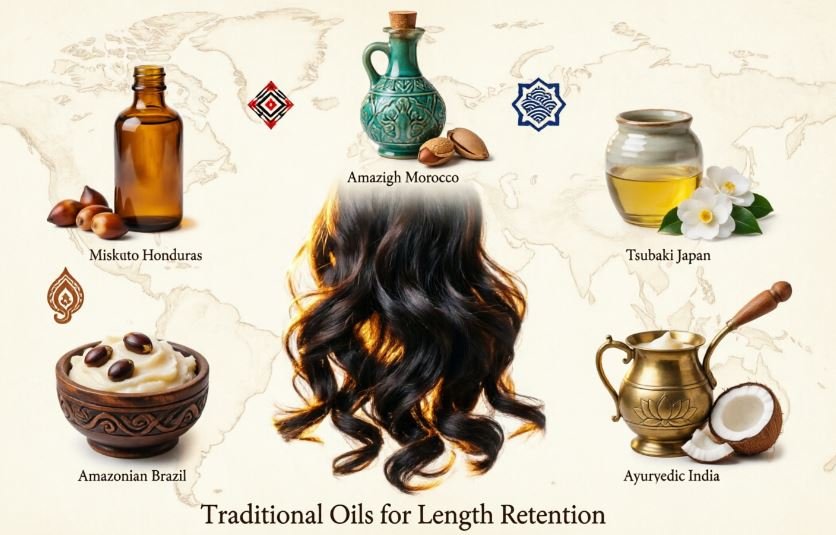
The phrase secret indigenous oils for extreme hair length sounds like folklore, and partly it is. Here is the honest takeaway up front: no oil switches your genetics into fairy-tale mode. What cultures from Honduras to Japan actually mastered was hair length retention — keeping every centimeter their scalps already produced. This article walks through the indigenous hair oils those communities really used, what each may support, and how their habits translate into a modern routine.
Indigenous oils like batana, argan, camellia, and coconut do not speed growth beyond your genetic rate. They may support longer-looking hair by reducing breakage, sealing cuticles, and keeping the scalp comfortable. Consistency over months is the real “secret.”
You have measured the same shoulder-blade plateau for two years. Ends snap faster than your scalp produces, and glossy “growth serum” ads keep promising what biology cannot deliver. Before you trust a third viral bottle, it helps to see what generations who actually kept long hair did differently.
Key Takeaways
- Extreme length stories are retention stories: genetics set the rate, habits keep the length.
- Batana, argan, camellia, coconut, pracaxi, babassu, monoi, shea, and baobab each fill a different slot.
- Match oil weight to porosity and climate, exactly as traditions intuitively did.
- Pre-wash penetration plus post-wash sealing is the pair every routine needs.
- Medical hair loss needs a dermatologist; oils stay in the cosmetic lane.
Why “Extreme Length” Is Usually Retention, Not Faster Growth
Scalp hair grows roughly one to one-and-a-half centimeters per month during the anagen growth phase. Your anagen window, set mostly by genetics, decides how long a strand lives before shedding. That ceiling explains why two people using the same oil end up with very different lengths.
What changes between people is retention. A strand that survives three years looks dramatically longer than one that snaps at eighteen months. Traditional hair growth oils enter the story here — not as a speed dial for follicles, but as protection for the length you already own.
What oils can honestly change
Lubricated strands face less friction from combs, pillows, and styles. Sealed cuticles lose less moisture and split less often. A comfortable, flake-free scalp supports a healthier shedding cycle. None of that is regrowth medicine; all of it is retention physics.
What oils cannot change
They cannot restart scarred follicles, override hormonal thinning, or extend anagen past your genetic window. Any page promising otherwise is selling fantasy. Dermatologists treat scarring and hormonal hair loss with medical tools, not kitchen oils.
The Miskito Secret: Batana Oil from La Moskitia
The most searched ancestral hair care secret today belongs to the Miskito people of Honduras’ La Moskitia coast. Their women have hand-pressed the nut of the American oil palm into a thick, earthy paste for generations, and regional folklore credits Miskito batana oil with remarkably long, dark hair.
Modern analysis shows why the paste feels special. Elaeis oleifera oil is naturally rich in oleic and linoleic fatty acids, vitamin E tocotrienols, and carotenoids — the same compounds cosmetic chemists now bottle for shine and breakage care. Anecdote is not clinical proof, but the conditioning logic is sound.
How batana oil is traditionally made
Nuts are collected, roasted or boiled, then pounded and pressed by hand. The roasting step creates the signature coffee-like scent and deep amber color. Raw batana oil keeps heat-sensitive antioxidants that clear, deodorized versions lose, which is why unrefined batana oil smells and looks the way it does.
From village paste to modern bottles
Today, La Moskitia hair oil reaches most readers as bottled oil rather than paste. Look for “raw” or “cold-pressed” wording and expect thickness plus scent. Our UFNA Batana Hair Oil review examines one bottled raw version against these exact checkpoints, for readers who prefer a verified starting point.
The Amazigh Gold: Argan Oil from Morocco
Long before influencer culture, Amazigh women in southwest Morocco pressed argan kernels for cooking and cosmetics. Their indigenous hair care rituals centered on argan’s unusually balanced fat profile and vitamin E content, which is why argan oil for hair absorbs faster than heavier butters.
For length work, argan shines as a daily ends serum. A couple of drops smooth flyaways and add slip for detangling, and it may support shine and softness without the grease complaint heavier oils trigger.
Why argan feels lighter than batana
Argan carries a higher share of lighter-texture fats and less saturated fat than palm-derived oils, so it spreads thin and sinks in quickly. Fine-haired readers who found raw batana heavy often tolerate argan well on mid-lengths.
How to borrow it today
Use two drops on damp ends after washing, or mix a few drops into your weekly mask. Store it away from sunlight, because vitamin E degrades in heat and light.
The Japanese Ritual: Camellia (Tsubaki) Oil
Ohshima island women and Edo-period courtesans combed camellia oil through their hair for centuries, and the tsubaki oil tradition survives in modern Japanese hair care. Camellia oil for hair is oleic-dominant, closely mirroring the skin’s own sebum, which explains its glassy shine finish.
Used the traditional way — a few drops on a wooden comb, worked from mid-lengths to ends — it may support smoothness and static control. It also doubles as a winter scalp massage oil when dry air stresses the barrier.
Best ways to use camellia on ends
Apply to damp, not soaking, hair after washing. Warm the drops between palms first, then glide rather than scrunch. For deeper care, blend a teaspoon into your pre-wash oil mask once a week.
The Ayurvedic Classics: Coconut, Amla, and Bhringraj
India’s hair tradition is a trio, not a single oil. Coconut oil pre-wash soaks remain the most studied habit of all: small trials suggest coconut reduces protein loss during washing because its lauric acid penetrates the shaft. Amla oil for hair brings vitamin C and antioxidants to scalp tonics, while bhringraj oil (Eclipta alba) carries the folk title “king of hair,” though human evidence stays thin.
Why coconut still beats many modern serums before washing
A 20–30 minute soak limits the swelling and protein leak that shampooing causes. That single weekly habit is one of the cheapest length-retention tools anywhere, and it pairs well with any sealing oil afterward.
Where amla and bhringraj fit
Think of them as scalp tonics rather than strand sealants. Traditionally they were massaged in before washing, and modern users keep that order to avoid buildup on colored or fine hair.
The Amazon Basin: Pequi, Pracaxi, and Babassu
River communities in Brazil have long used pequi oil for taming unruly strands, pracaxi oil for its unusually high behenic acid slip, and babassu oil as a light, fast-absorbing moisturizer suited to humid climates.
For length work, pracaxi’s slip makes detangling gentler, babassu suits fine hair that hates heaviness, and pequi adds gloss to coarse textures. Tradition here taught climate matching — a lesson modern routines often skip.
Which Amazonian oil suits fine hair
Babassu, clearly. It absorbs quickly and leaves little residue, so fine strands keep volume while still gaining slip and shine. Pracaxi is better reserved for weekly detangling sessions on thicker textures.
The Pacific and West Africa: Monoi, Shea, and Baobab
Tahitian monoi oil — coconut oil infused with gardenia flowers — serves as a sun-and-salt shield for Pacific hair. West African routines lean on shea butter hair sealant as the final layer over damp hair, while baobab oil offers a middle-weight option rich in both fatty acid families.
Sealants vs penetrators: a quick rule
Penetrating oils (coconut, babassu, camellia) work best before washing. Sealing butters and oils (shea, baobab, castor) work best after, locking in the water you just added. Indigenous hair care rituals intuitively paired both; your routine should too.
How to Choose Your Oil by Porosity and Texture
Porosity decides whether an oil sinks in or sits up. Oils for low porosity hair should be lighter and penetrating, applied with warmth to tight cuticles. Oils for high porosity hair should be richer sealants layered after water-based moisture, because raised cuticles lose hydration fast.
A simple spray test helps: water beading on a strand hints low porosity, while instant soaking hints high. Results vary, so treat it as a starting clue, not a lab test.
| Oil | Tradition | Feel | Best for |
|---|---|---|---|
| Batana | Miskito, Honduras | Rich, raw | Coarse, dry, high porosity |
| Argan | Amazigh, Morocco | Light-medium | All types, daily ends |
| Camellia | Japan | Light, glossy | Fine to medium, shine |
| Coconut | India | Penetrating | Pre-wash, all types |
| Babassu | Amazon | Very light | Fine, low porosity |
| Shea | West Africa | Heavy sealant | Coarse, high porosity |
We unpack the fatty-acid science behind these pairings — oleic vs linoleic ratios — in a separate guide: the Best oleic acid and linoleic acid balance for hair porosity.
Common Myths About Indigenous Hair Oils
Myth 1: Oil makes hair grow faster. Growth rate lives in your follicles and genetics. Oils protect the length after it leaves the scalp.
Myth 2: More oil equals more length. Over-application clogs the scalp and weighs strands down, which increases friction breakage during styling.
Myth 3: Raw is always better. Raw keeps more antioxidants, but fine hair may prefer a lighter refined or blended oil for daily use and save raw versions for masks.
Myth 4: One oil fits everyone. Traditions matched oil weight to climate and texture. Copying a single viral bottle ignores that entire lesson.
Single Oils vs Blends: What Traditions Actually Did
Village routines rarely mixed ten oils into one bottle. They used one penetrating oil before washing and one sealant after, sometimes scented with local flowers like gardenia in monoi.
Modern blends can be convenient, but read labels carefully. A trustworthy blend names every oil and its position in the list; a marketing blend hides mineral oil and perfume behind the word “fragrance.” For natural oils for hair breakage, a single-ingredient cold-pressed hair oil remains the easiest choice to patch test and trust.
A Length-Retention Routine Any Tradition Would Recognize
Step 1: Pre-wash soak
Once weekly, apply a penetrating oil from roots to ends 30 minutes before shampoo. This cuts swelling and protein loss, and it is the single highest-value step in this guide.
Step 2: Detangle with slip
Never fight dry knots. Work a sealing oil or conditioner through damp hair with fingers or a wide-tooth comb, starting at the ends. This is where the best oils for split ends earn their keep.
Step 3: Protect while you sleep
A loose braid or satin pillowcase plus one drop of oil on ends reduces pillow friction — the quiet killer of length. An overnight oil mask once a week fits neatly into this step.
Step 4: Massage and repeat
Two minutes of scalp massage for circulation with your chosen oil, 2–3 times weekly, keeps the scalp comfortable and the habit alive. Pair these steps with our to Manage Hair Breakage Naturally checklist for compounding gains.
Safety Notes Traditions Never Had to Write
Patch test any new oil on your inner arm for 24 hours, especially nut-derived ones like batana and coconut. Stop if redness or itching appears. Pregnancy, nursing, or existing scalp conditions warrant a doctor’s nod first.
One medical line matters: scarring (cicatricial) alopecia destroys follicles permanently, and no oil regrows them. If your scalp shows shiny bald patches, see a dermatologist; our upcoming guide on the best natural oils for cicatricial alopecia scalp will cover comfort-only options alongside medical care.
Authenticity is the other modern risk. Adulterated “indigenous” oils diluted with mineral oil are common on open marketplaces. Buy from verified sellers, and prefer labels that name one oil instead of a perfume blend.
FAQs About Indigenous Hair Oils
Q1: Do indigenous oils really make hair grow longer?
Ans: Not faster than your genetics allow. What they may support is length retention: less breakage, sealed cuticles, and a comfortable scalp mean more of your natural growth survives. Traditions paired oils with gentle handling and protective styles, and that combination — not the oil alone — produced the extreme lengths in folklore.
Q2: Which oil is closest to the original Miskito batana paste?
Ans: Raw, unrefined bottled batana oil. Look for “cold-pressed” or “unrefined” wording, amber color, and a roasted coffee-like scent. Clear, odorless versions have been refined and lose some carotenoids and tocotrienols. Our UFNA Batana Oil review checks one bottled raw option against these exact markers.
Q3: Can fine hair use heavy indigenous oils like batana or shea?
Ans: Yes, in tiny doses and only on ends. Two to three drops warmed between palms is enough for fine strands. If grease appears within an hour, switch to babassu or camellia for daily use and keep batana or shea for weekly masks.
Q4: How long before length-retention results show?
Ans: Breakage reduction usually appears in 4–6 weeks as fewer snapped strands in your brush. Visible length differences follow the growth cycle, so compare photos at 3-month marks, not weekly. Consistency beats intensity every single time.
Q5: Are these oils safe for color-treated hair?
Ans: Generally yes, because pure plant oils contain no sulfates or solvents that strip dye. Coconut pre-wash soaks may even slow color fade by limiting wash swelling. Patch test first, and avoid heavy sealants right before salon appointments so your stylist works on clean hair.
Q6: Where can I buy authentic raw batana oil today?
Ans: Through verified retail listings rather than social-media checkout pages. Check that the ingredient list names only Elaeis oleifera oil, confirm the seller and return policy, and read independent reviews before paying. Our UFNA Hair Oil review walks through one verified bottled option against these checks.